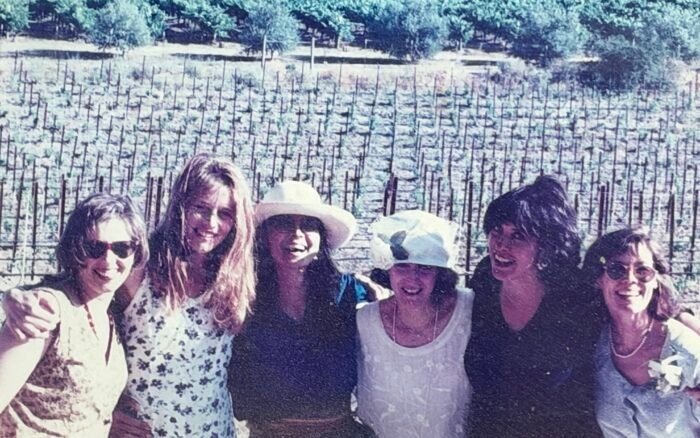
We came to call ourselves Thursday Night Writers. I first met with this group of women on July 8, 1984, 42 years ago. I had previously joined a group led by Elizabeth, but it didn’t work out, so she suggested I join an already-formed women’s group. The group met at the Sitting Room in Rohnert Park, a funky storefront in a strip mall, rented by a professor and frequented by students and faculty. That first evening, I sat in my car as several women gathered by the locked door. Dianne, with her stylishly cropped black hair with a purple sheen, leaned in to speak to elegantly blonde Jimalee, who was snuggling next to Jan, beautiful with her long black mane, as they all waited for Elizabeth to arrive. I stayed in the car. Two or three other women approached as Elizabeth drove up and unlocked the door. I felt shy. Would they accept me into this seemingly close group? It would take me some years to feel like I was a core part of it.
In those early years, we freewrote for 20 or 40 minutes, often on a theme, then read our work aloud to each other. We often used prompts. The group ranged from five to seven members over the years and became my audience. I had been in writing groups before and knew how hurtful criticism could be. Once, a flippant comment from a young student put me off writing for months, however accurate it may have been.
But that never happened with this group. Over time, we came to trust and respect each other and each other’s work. Criticism was useful. We grew as writers as we wrote through pregnancies, raising kids, divorces, weddings, the deaths of parents and friends and spouses and siblings, and, as the years added up, illnesses.
Jan’s descriptions were like fine porcelain. She wrote about beauty—the smoothed smudge of purple eyeshadow (you could see it when she described the woman) or the (beloved!) scent of her giant dog, Reba, definitely a smelly dog, in my opinion. She loved fiercely and forever, and that love was tempered with wisdom. In later years, as she studied Bowen Theory and developed a private practice, her words offered a perspective beyond my training and orientation as a Jungian analyst. I always learned something a little different.
Jan didn’t like to talk about death. That I remember from the beginning. More than once, I wrote a freewrite about the time we would each pass away, one by one, and she remarked that I always got into the dark details. I took that as a compliment, though I am not sure she meant it that way.
In retrospect, there were signs. She began making agendas instead of writing descriptions. She reported that she had lost her sense of smell. After the pandemic, she did not want to go out. She hinted that something was wrong. We encouraged her to see a doctor, but she said she was afraid to hear what it might be.
We had our last meal with her on the evening of December 29, 2023, after an afternoon of writing. We sat around Jimalee’s round dining table, bedecked with linens and antique china. What soup had Jimalee prepared? I don’t remember. But the darkening hour brought warmth and gratitude for our many years together, sharpened by the loss of one of our members, Norma, earlier that year. We were keenly aware of how precious communion was.
Jan only picked at her salad, but that wasn’t unusual. Still, we worried because she had lost a lot of weight. She and I laughed as we playfully fought over chocolate, something she’d never had to learn because she had no siblings. We noticed she hadn’t bathed or groomed herself, which was highly unusual. Her now-gray hair was pulled back. She was anxious to call her husband, Don, “her rock,” and leave.
We said goodbye when he arrived, as if it were an ordinary goodbye. She would never return, despite our repeated pleas for her to join us. Don tried to convince her to come. I think it was just too much for her, the gap between who she was and where she was now. Our only contact became periodic updates from her daughter: Jan was hospitalized after a fall and a head injury. She was in rehab. She was in a board-and-care; she was home on hospice. Once she was settled, her daughter would arrange a visit. And then that final message in August: Jan was gone.
You rarely know when a meeting is your last, but you do know there will be one. That comes from living many years and accepting mortality. As with all passings, I question what I should have done differently. Should I have pushed to see Jan, even though I know how private she was? Were there things we could have done to make her more comfortable in the group as she lost her mind? Why didn’t I just send cards?
But I do know this group of women has taught me this: our task is to bear witness, with an open heart, to whatever is before us, including loving the simple pleasure of sharing our lives, in print, in gossip, and over soup, throughout our lifetimes.