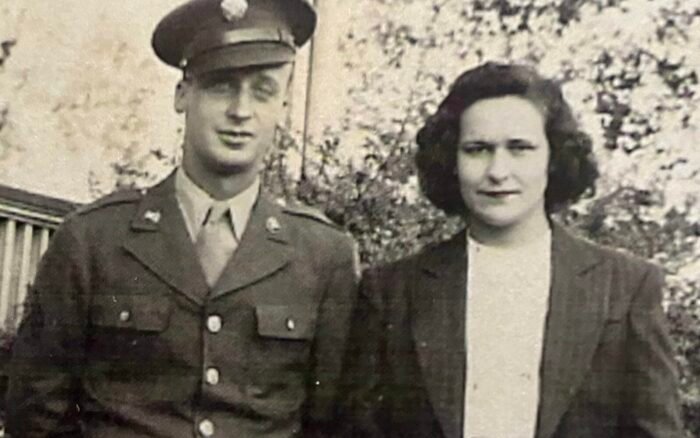
This year, I discovered a side of my father I had not known. My sisters, Judy and Shelly, and I were sorting through family items in Judy’s attic, including a box of my father’s letters my mother had saved during Dad’s service in the Second World War. The letters begin after they met on a blind date in January 1942. My mother was 16, a college freshman, and he was 21. The first letter is formal, inviting her to a second date and joking that my grandparents’ dog, Tony, had bitten him on the first date.
When he was inducted into the Army later that year, the letters changed. He trained in Florida, which he hated, and was transferred to Salt Lake City after he became sick with hepatitis. Throughout the letters and the years of training and subsequent stationing in various places, writing to my mother was the center of his life. More than once, he reminisced about their first date. “Ever since I was old enough to even begin to think that I may someday marry, I have been planning my ideal life partner. Frankly, I had begun to think that I had set my specifications too high. I had known quite a few girls, but none had even come close. I was beginning to think I was going to have to be an old bachelor. Then I met you.”
He continued, “You are all I have ever hoped for or even could hope for. Believe me, I have waited for you for almost 25 years and I would wait 25 more.”
More than once, he wrote, “You know, it certainly means a lot to one to have someone waiting for you.”
I knew he felt this way about my mother, but I did not know how passionately he could express it, and how often!
In early 1945, my father was sent to the South Pacific theater and specifically to Tinian in the Mariana Islands. His letters were censored. We found letters with lines cut out. After he arrived in the Marianas, he wrote almost every day.
There are saved copies of letters to my grandfather telling him about my father’s plan to marry my mother, and asking about land available to farm when he returned. Those servicemen returning earlier got first choice. And then there was the kerfuffle when Dad accidentally slipped the letter he’d written to my mother into the envelope for his own mother! The three of us laughed at the thought of our grandmother reading his lovesick ramblings.
He was such a good writer! I had seen little of his writing before. In my entire life, he wrote me only one letter after we had a row when I insisted on bringing my California boyfriend home to Illinois and sharing a bed, even though we were not yet married. It was a conciliatory letter; one he said my mother made him write. He wrote that there was room at his table for my boyfriend, but not in my bed in his house. He asked me to humor my old father, and my rebellious self did.
I saw a wise and thoughtful side of my father as he counseled my mother on whether to finish the last year of her degree or accept the teaching position being offered. “As you say,” he wrote, “it is just a degree, but at the same time, the teaching job is just teaching. … I really think you would get more advantage from another year of school. You have spent three years toward that degree, and I expect you would always regret it if you did not finish up. Not that I have the least doubt that you are capable of teaching now. I am positive that you could handle it very well. I think you would enjoy the year of school a little more besides. Not that it isn’t a steady grind, but you have many friends your own age. Teaching you would be with some pretty cranky old maids. And you would have a lot of parents to put up with. Then, another way, it would be nice for you to be at home for your meals. And not to have to worry too much about transportation. I am sure your parents would enjoy having you at home too.” He added, “Education is something you can never get too much of. When you have the opportunity to get more, you should think long before you pass it up.”
This came from a man whose father wouldn’t allow him to accept the college scholarships he was offered because a farmer wouldn’t need a college education. In fact, my father was the youngest of four brothers and the first in the family to graduate from high school.
But he added advice to my mother, “What you really decide deep down inside is the right thing. No matter which way you decide, I am sure you will make a success of either one.” My mother chose to graduate. I later read that, in fantasizing about their life together, he imagined their children would go to college.
In these letters that my mother saved for 60 years, I saw how the image and the memory of her, the dreaming into the life they would build together, held him through days away from home, doing things he did not understand. War is terrible, and my father knew it. In May 1945, just three months before the United States dropped the atomic bomb, which was serviced on Tinian, my father wrote, “I really feel sorry for the children of the future when they start studying this war. The first one was enough to have to study. They will have a lot of battles, etc., to cover. They will think they were born ‘twenty years too late.’”
In the last months of the war on Tinian, my father wrote, “There is so much going on, but so little I am allowed to tell you.” When he first arrived, he did not receive letters for some time. Then, finally, one day, he received 25, 16 of them from Mom. He wrote, “Did you ever eat cake and leave the icing until last just so you would have a good flavor in your mouth? That is what I did. I read the others, then I sat back and really enjoyed yours. And I do mean enjoyed them. It really means a lot to have such a wonderful person waiting for me back home.”
In another letter, he quizzed her on where to go on their honeymoon and where they would live. Would she prefer to stay in a cabin in Wisconsin (his first choice) or at a hotel? “When the time does come,” he wrote, ‘I think it would be a good idea to have our home all ready to move into before we go on our honeymoon. Then we could come back, pick up Susy [the dog](if your mother will let her go), and I could carry you over the doorstep of home. Our home. It might not be very elaborate, but it will do until the time comes when we can have one that is really ours. Any place would seem like a castle to me if you were in it…”
In answer to her concerns about life in the country (for she had grown up in the city), he wrote, “As far as the moon in the country is concerned, however, until you have seen the moon come up there, you have never lived. On a warm summer evening, say July or August, when there is the sweet smell of clover in the air (fresh country air, not that impure city stuff you call air), there is nothing to equal the beauty of a large red moon coming up on the horizon and slowly turning to silver. Unless it is that same moon coming up on a cold, clear winter night. In the years to come, we will see that moon many times together. Of course, I probably won’t see it when I am with you, unless I see it reflected in your eyes.”
My sisters and I reacted differently to finding these letters, which we scanned to save for our children. I knew him primarily as a quiet, introverted man of few words, but these letters revealed a deeply romantic, thoughtful side of my father that I had seldom seen. To Judy, reading the letters felt intrusive, although Shelly reminded her that, in most of them, he knew someone was looking over his shoulder and censoring anything he shouldn’t include about what he was doing and where.
This Father’s Day, I am deeply appreciative of this man, who had such a gentle heart and kept his soul and spirit alive by writing to my mother every day through a very difficult time.