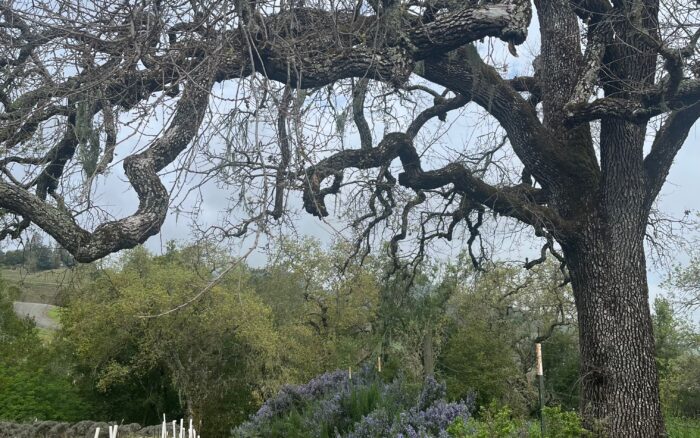
The beloved valley oak in the historic pioneer cemetery, whose generous boughs have graced our lavender field for many years, is not leafing out. We feared her demise. Last year, when a branch died abruptly, an arborist diagnosed Mediterranean Oak Borer (MOB). We cut the infected bough, irrigated the top six inches in the heat of summer, and hoped against hope that the tree’s vitality would carry her through. When another branch died, we had it cut as well. The tree, once beautiful with its great limbs sweeping the heavens, became a shadow of itself. Our attempts to save her only made her smaller and odder.
Our iconic valley oaks are showing signs of stress and dying. Those ancient trees have defined Napa Valley for centuries. Sadly, 98% of these oaks have been cut for agriculture and development. Now they are threatened by invasive MOB.
In January of this year, two members of the Sierra Club Forestry Group spoke with Mike Jones, Forestry Advisor with UC Cooperative Extension, about the latest research he and Curt Ewing, an entomologist with CalFire, are conducting on MOB. MOB has been in California for 6-7 years, and because it is an invasive species, we are only now learning about its habits. It spreads among legacy oaks and is a particular problem in urban forests because trees are so close together. When the insect infests a tree, it farms a fungus that is toxic to the tree, and then spreads to nearby trees. The latest research, Jones says, is examining chemical control of high-value trees and how to dispose of infected wood.
Stressed trees are at greatest risk. We are on a warming planet, and in California, that means more severe cycles of drought and flooding. The severe drought from 2012 to 2016 certainly stressed our oaks and may have made them vulnerable to MOB. The most important thing we can do is keep our valley oaks healthy. Jones suggests mulching under the tree’s drip line to cool the soil and retain moisture during hot, dry summer months. Sanitary pruning and irrigating the top six inches of soil before summer heat events may also help reduce stress on the tree.
But what do you do if a valley oak, like the one in the pioneer cemetery, is obviously stressed and dying, and an arborist gives you the diagnosis: MOB? The use of chemicals is a double-edged sword: they kill not only the target but also everything else, and they are expensive. A cocktail of an insecticide for the host and a fungicide for the fungus can be applied as the tree is leafing out. Will this work? Current research focuses on which chemicals work and when to apply them.
Arborists recommend cutting a stressed, visibly infected tree to avoid the spread of the insect. This is not only heartbreaking, but also expensive. Cutting a valley oak can cost $10,000. And if you chose to do this, the next question is what to do with the wood?
At first, it was thought that solarizing the wood by wrapping it in clear plastic for six weeks in the sun would kill MOB, but this has proven ineffective. Chipping or burning the wood is recommended. Again, the logistics are overwhelming. Where is the wood burned or chipped? We need solutions.
The best solution so far is to keep our valley oaks healthy. Mulch the tree (not the trunk) and consider irrigating the top six inches under the drip line before heat events during the dry season. Perform sanitary pruning of the tree. If you have an infected tree, consult an arborist about chemical treatments. If you cut an infected tree, don’t transfer firewood to other locations, as this is how MOB spreads. Chip or burn it immediately. (According to Jones, It is okay to use the chipped wood from an infected tree as mulch. It will not spread MOB.)
Finally, ask your city and county government to budget for the care of our valley oaks and the disposal of infected wood. We need designated areas for burning or chipping infected wood. We also need to alert everyone not to move infected oak firewood, as this is how MOB will spread.