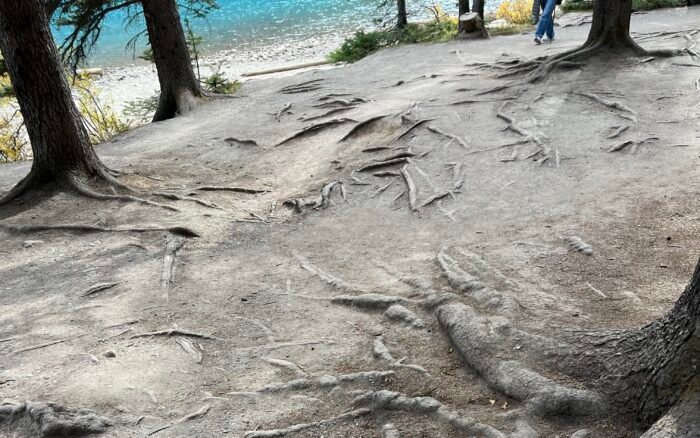
The path alongside Moraine Lake (Banff National Park) is packed earth, polished by hikers’ feet and interrupted by smooth, exposed roots of lodgepole pine and white spruce. The lake is the turquoise blue of glacial runoff, surreal in its beauty, a mirror of the mountainous backdrop and what remains of the glacier above. No wonder we all want to be here! We meet hordes of people on the trail, many bussed here as early as 4:30 am this morning. They carry tripods and backpacks. Brides in flowing white gowns pose with their grooms on rocky outcroppings for wedding photos. Some hikers climb well-worn trails to higher, less crowded spots, but most gather below our cabin, advertised as a place of calm, take selfies, and head back to the buses that brought them as more arrive. My husband Bruce says this is Disneyland.
We expected “The Jewel of the Rockies” to be remote and quiet. The website described the lodge as the “ultimate getaway for travelers seeking an unforgettable and elevated escape.” What it did not say is that, in a very small area, you would be sharing that escape with 6000-8000 others each day, even at the end of the season. Yes, that is an unforgettable experience!
“When we began building our Banff lodge over twenty years ago, we wanted to provide an oasis of calm, an escape from people’s busy lives. Today, our philosophy remains unchanged…” That was the hook for us, along with the promise of breathtaking beauty. Good advertising plays on our longings. This “oasis of calm” is best found in our hotel room.
I love to travel. I have written about it before. Some of the places I have visited are overcrowded. I remember touring the Sistine Chapel thirty years ago, shoulder to shoulder with fellow visitors, hoping there wouldn’t be a stampede. I barely had the courage to look up at God creating Adam, afraid of tripping and being trampled to death.
Once, when we arrived on an ocean cruise for an afternoon tour of Santorini, our cruise ship was one of seven that inundated the old town with tens of thousands of tourists for three hours. The townspeople’s shops sold us items before we rushed back to our cruise ships, but at what cost to their community, and, quite frankly, to us? What fantasy drives us to such experiences?
On Visit Napa Valley, the hook is “indulgence at every level.” The site promises that if we visit Napa Valley, “you know that you are experiencing the very best life has to offer… a true taste of the good life.”
The good life? In a county where workers serving tourists at wineries and hotels cannot afford to live where they work? Where, for just $160, you can taste wine with a curated snack? A county where nearly 50% of architecturally beautiful wineries are failing?
In the Sistine Chapel, God and Adam reach toward each other, their fingers only an inch apart. They do not touch. Art historians interpret this slight gap as symbolizing free will and the eternal distance between the human and the divine.
As tourists, are we reaching for the divine? For a greater sense of wholeness and beauty? To grasp the totality of this living planet, Gaia? Are we misguided?
What does this search mean in the context of our bond to home?
I carry this question as I travel, drawn to transparent, clean waters and lodgepole pines that have found narrow ledges where they flourish, humbled by how completely and devastatingly an untended forest burns after millennia of management. I still have the gifted chestnut from an ancient tree along the Camino in my pocket (to stave off envy), and I remember the Spanish winemaker in his garage (we did not speak the same language) who offered me a taste of his rosé and a handful of grapes to carry on my way.